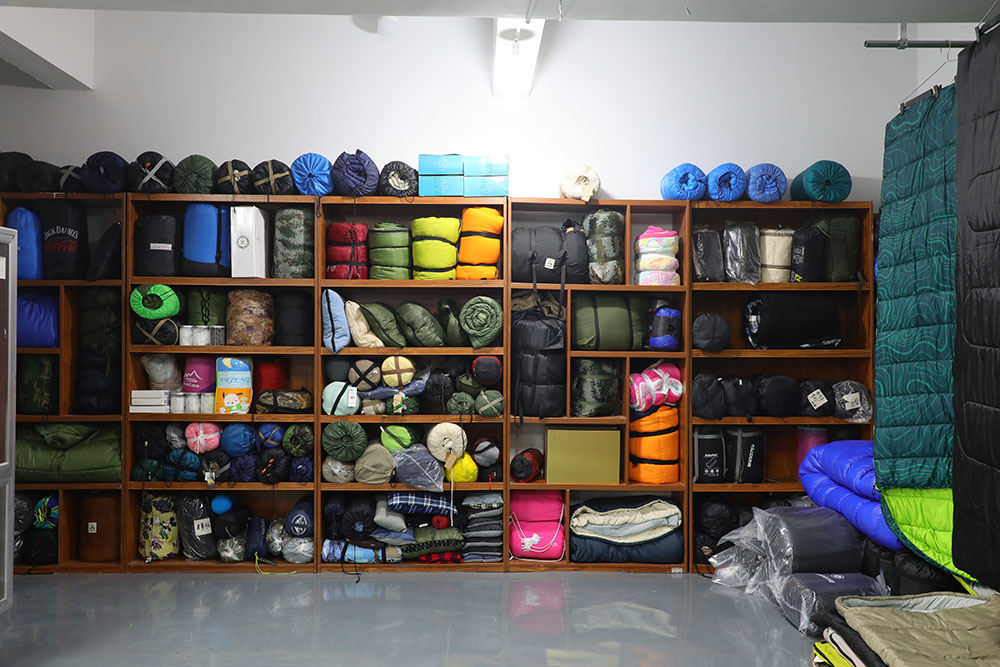
This guide is written for government emergency procurement departments, NGO logistics officers, international aid project procurement teams, and distributors. It covers material standards, core selection indicators, size specifications, storage requirements, supplier screening, and incoming inspection—providing a comprehensive framework for bulk procurement of emergency sleeping bags from China. For a broader understanding of how emergency relief sleeping bags fit into the overall relief supply system, you may also wish to read our article Complete Guide to Emergency Relief Sleeping Bags | 2026 Selection Standards · Stockpile Configuration · Procurement Practice Guide, which provides foundational knowledge to complement the detailed selection criteria covered here.
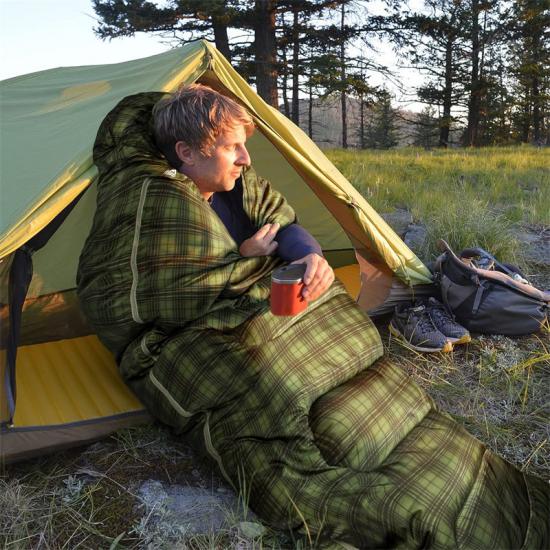
I. Positioning and Scene Adaptation: Emergency Relief Sleeping Bags Are Not Camping Gear
When Is It Mandatory to Use Professional Emergency Relief Sleeping Bags Instead of Standard Consumer Products?
A sleeping bag truly intended for post-disaster temporary resettlement sites, emergency shelters, bulk relief distribution programs, or government emergency stockpiles is fundamentally different from a retail camping version. Professional emergency models are designed around batch storage, standardized distribution, repeated handling cycles, and sanitization compatibility. They must remain reliable under high-density use and extreme environmental conditions.
Three core use scenarios and their respective priorities:
Post-disaster resettlement: Temporary camps set up after earthquakes, floods, or typhoons prioritize ease of transport, stackability, flame-retardant safety, non-irritating fabric odor, and mold resistance in humid conditions. Typically distributed as one unit per person.
Government stockpiling and contingency planning: National or regional emergency supply depots require long storage life, convenient rotation management, clear batch labeling, stackable packaging, and complete inventory recordkeeping.
International aid and NGO projects: Supply requirements tied to international organizations or bilateral aid programs focus heavily on documentation compliance, destination-country safety standards, and compatibility with project inspection and acceptance procedures.
Key differences in priorities by buyer type: Government agencies emphasize standards compliance and completeness of quality inspection documents; NGOs and international organizations prioritize delivery efficiency, cross-border clearance support, and overall cost-effectiveness; distributors focus primarily on pricing structure and sustained supply capability. Different roles looking at the same shipment are often thinking about entirely different things.
For projects serving a significant proportion of children, elderly persons, or injured individuals, size generosity and material safety should be factored into the selection process at the specification stage. See Section IV for specific sizing recommendations.
When sleeping bags are used in high-density arrangements inside enclosed tents, prefabricated shelters, or indoor gymnasiums, the flame retardance of emergency sleeping bag fabric represents a foundational safety requirement. Non-compliant materials that come into contact with the open flame or high temperature of temporary heating equipment can trigger uncontrollable chain fire risks. Professional waterproof cold-proof emergency relief sleeping bags should include flame-retardant test reports within their product documentation. Commonly referenced standards include GB/T 17927 and equivalent international testing methods. Flame-retardance data should be required from suppliers during the materials confirmation phase—not discovered as a missing document during final inspection.
III. Core Selection Indicators: What Are the Four Dimensions That Really Matter for Emergency Relief Sleeping Bags?
This is one of the most frequently asked questions from procurement teams encountering this product category for the first time. The following four dimensions are the critical judgment points that determine the quality outcome of any bulk emergency relief sleeping bag procurement project:
(1)Fill type and fill weight determines the insulation rating and must be cross-referenced against the nighttime temperature range at the deployment location. The specification gap between spring-autumn resettlement conditions and extreme-cold winter regions is significant—a single universal specification is not advisable.
(2)Waterproof rating and outer shell coating affects reliability in humid operating environments. The waterproof rating of emergency sleeping bags is typically assessed using hydrostatic pressure resistance testing. Specific requirements should be defined based on the deployment scenario—indoor gymnasium, canvas tent, or prefabricated shelter—and local climate characteristics.
(3)Shell fabric density and three-dimensional tear resistance relates to durability and service life, directly influencing the frequency and cost of batch rotation and overall project budget.
(4)Structural design and compressed pack volume affects storage efficiency, transportation cost, and field distribution speed. Bulky compressed units increase per-unit freight costs in container shipping and raise labor requirements during on-site distribution.
IV. Size Classification and Selection Guide
By Insulation Rating: How to Choose Between a Standard Season Model and a Winter Heavy-Duty Version
Standard season models—intended for environments where nighttime temperatures do not drop below approximately 5°C—are designed primarily around lightweight portability and represent the standard configuration for short-term resettlement in mild climates. Winter warm emergency relief sleeping bags carry measurably higher fill weights and insulation layers, and their specification parameters must be carefully matched to the actual thermal conditions of the deployment environment.
For projects where destination climate conditions are uncertain, a two-tier configuration strategy combining standard-weight and heavy-duty versions is recommended: standard models for the majority of the general adult population, with heavier-duty versions reserved for children, elderly persons, injured individuals, and groups with elevated cold-exposure risk. This tiered approach enables cost control while ensuring adequate protection for vulnerable populations.
By Size: Standard, Extended, and Oversized Wide-Body Models
Standard sizing covers adults in the 160–175 cm height range and represents the primary specification for most projects. Extended sizing accommodates adults taller than 175 cm; in practice, allocating 15%–20% of total quantity in extended size is commonly recommended. The oversized wide warm emergency sleeping bag is suitable for larger-framed users or scenarios requiring additional internal space—such as patients with fractures—and is typically listed as a separate line item in humanitarian aid project supply manifests.
By Packaging Format: Stuff Sack, Vacuum Compression, and Roll Pack
Stuff-sack packaging is ready to distribute immediately upon unpacking, but offers lower volume efficiency per carton. Vacuum compression packaging achieves the smallest possible storage and transport footprint but requires recovery time after opening—making it better suited to stockpile projects than to high-speed emergency deployment. Roll packaging sits between the two extremes and is appropriate for projects that need to balance storage convenience with reasonably fast deployment capability. The choice should be guided by warehouse spatial constraints, available distribution staffing, and the time window available for resettlement operations—not simply by per-unit packaging cost.
Customization Capability: What Parameters Can Typically Be Adjusted for a Specific Project?
For projects with specialized requirements, established emergency relief sleeping bag manufacturers typically support customization of color, logo printing, label language—destination-country language plus English—packaging format, and batch identification. Some factories can also adjust fill weight or outer shell fabric composition per project specifications. Customization requirements generally affect minimum order quantities and lead times and should be confirmed with suppliers early in the specification validation phase.
V. Price and Total Cost of Ownership: Procurement Is Not Just About the First Line of the Quote
Unit price is not the only metric for evaluating the true cost of a batch of emergency sleeping bags. A complete cost analysis should account for service life and durability—frequent damage requires more frequent replenishment, accumulating additional procurement and warehousing management costs; the impact of compressed pack volume on freight—the same quantity of sleeping bags at 20% higher compressed volume can generate meaningfully higher total costs in full-container-load ocean freight; and the project-level cost of inspection failure—for government or international aid contracts, a failed inspection often delays an entire delivery milestone, with consequences that far exceed the cost difference of sourcing higher-quality products upfront.
For cross-border projects, the efficiency gain from consolidating clearance batches and reducing supplier contact points is sometimes more valuable than shaving a few dollars per unit off the item price. A recommended approach during the comparison stage is to build a complete framework covering unit price plus expected service life plus estimated freight plus supporting service costs, rather than relying solely on the headline figure in a quote.
VI. Storage and Maintenance: Once Purchased, How Long Will This Inventory Last?
Emergency relief sleeping bag storage conditions directly determine actual usable service life. The most commonly overlooked points in bulk inventory management are as follows:
(1)Temperature and humidity control It is recommended to maintain storage temperature within the 10–30°C range, with relative humidity controlled below 60%, to prevent material degradation or fill clumping caused by prolonged exposure outside this range.
(2)Light protection and compression management Long-term direct sunlight accelerates fabric aging; excessive stacking pressure causes permanent compression set in fill material. Stacking height should not exceed 70% of the warehouse's actual rated load-bearing capacity.
(3)Batch labeling and rotation scheduling Each incoming batch should be recorded with production date, batch number, and warehouse entry date. A systematic inspection cycle every 3–5 years is recommended, with rotation or extended-use decisions made based on inspection results. Emergency supplies may sit in storage for years without deployment—if defects are only discovered at the point of activation, corrective action is almost always too late.
(4)Post-deployment recovery and disposal Sleeping bags returned from field use should be fully air-dried and sanitized before being returned to inventory. Units showing significant wear or functional failure should be flagged for disposal prior to re-entry, preventing them from being mixed with serviceable stock.
VII. Supplier Screening and the Six-Step Procurement Process
Breaking the procurement process into defined steps and executing them in sequence is consistently more effective than rushing to negotiate price at the outset.
Step 1: Prepare a one-page project requirements summary: Specify use scenario—disaster type and climate conditions—number of beneficiaries and population profile including any special-needs groups and their proportion, intended duration of use, destination country with clearance requirements, and budget ceiling range.
Step 2: Draft a technical specification: Cover outer shell fabric type or density requirement, fill material type and weight range, waterproof rating if applicable, flame-retardance standard reference, size-mix breakdown, and packaging format.
Step 3: Screen candidate suppliers: Verify completeness of production credentials and inspection documentation; confirm relevant project supply experience across government, NGO, and international aid categories; assess production capacity and expedited order handling capability; and evaluate one-stop product range and trade service capability. For orders associated with government or international programs, priority should be given to factories that proactively provide complete documentation with certification reference numbers.
Step 4: Sample validation and targeted testing: Request samples from 2–3 candidate suppliers and conduct comparative testing against the technical specification. Where required, commission a third-party testing laboratory to complete key item testing including tensile strength, waterproof resistance, and flame retardance.
Step 5: Contract terms finalization: The contract should explicitly state key technical parameters and permissible tolerances, delivery phasing and schedule, incoming inspection sampling rate and non-conforming product handling procedures, penalty clauses, and the boundaries of warranty liability.
Step 6: Incoming inspection and documentation archiving: Execute the following inspection checklist at goods receipt and retain all records for subsequent replenishment decisions and audit purposes.
Incoming Inspection Checklist
(1)Appearance and workmanship: Inspect a representative sample for damage, staining, visible loose threads, or significant color variation; verify zipper operation is smooth; confirm stitch density is consistent.
(2)Dimensions and weight: Measure against contractual specifications and confirm deviations are within the agreed tolerance; verify overall weight consistency across the batch.
(3)Fill distribution and loft recovery: Unfold and check that fill material is evenly distributed with no visible clumping or hollow zones; apply hand pressure and observe whether loft recovery speed meets expectations.
(4)Flame retardance and waterproof performance: Submit samples to third-party testing or cross-reference the provided test report as required by the project, verifying that report validity dates correspond to the correct batch.
(5)Packaging and batch identification: Confirm packaging integrity, batch number, production date, and language labeling are complete and accurate.
(6)Quantity verification: Cross-reference actual received quantity against the packing list and contract; document any discrepancies and initiate resolution with the supplier promptly.
If issues are identified during inspection, preserve the evidence immediately and initiate the handling process in accordance with the contract. Problems found during inspection are still remediable. Once defective units have been mixed into active distribution, the cost of remediation rises exponentially.
Practical reference: If you are currently drafting technical annexes or internal acceptance standards for emergency relief sleeping bags but lack a ready-made template, please submit your project background through this site's contact form. We will provide a general technical clause example in anonymized template form for internal reference and benchmarking purposes only. This does not involve any specific client information, and all final arrangements are subject to a formally signed contract.
IX. Common Procurement Pitfalls: Which Three Mistakes Carry the Highest Cost?
Pitfall Type 1: Using standard camping products in place of professional relief-grade equipment
What goes wrong: Selecting off-the-shelf outdoor sleeping bags based on "similar appearance" for bulk distribution.
Likely consequences: Consumer camping models typically lack flame-retardant treatment and formal inspection documentation. Their materials are not designed for high-frequency handling cycles, sanitization, or long-term storage, and they frequently fail project acceptance inspections. Field performance issues and complaints emerge quickly.
Prevention: Explicitly state "intended for emergency relief deployment in bulk distribution scenarios" in the technical specification, require the supplier to provide a flame-retardance report and scene-compatibility documentation, and let the technical requirements themselves serve as the filter.
Pitfall Type 2: Ignoring climate variation across deployment locations and distributing a single specification uniformly
What goes wrong: For multi-site projects spanning different climate zones, procuring a single insulation-grade sleeping bag for the entire allocation.
Likely consequences: Higher fill weight results in unnecessary cost in warmer regions; insufficient insulation generates complaints in colder regions. Both outcomes trigger additional supplemental procurement or exchange costs.
Prevention: At the requirements stage, segment destination locations by climate zone and specify the quantity split between lightweight and winter warm emergency relief sleeping bags, with each specification's applicable conditions noted in a contract annex.
Pitfall Type 3: Vague contract terms that leave no basis for accountability when problems arise
What goes wrong: A contract that only states "meets standard quality requirements" without specifying inspection standards or non-conforming product handling procedures.
Likely consequences: Upon discovery of quality issues at goods receipt, the supplier attributes the discrepancy to "subjective interpretation differences," and the buyer has no effective contractual basis for recourse. Remediation costs far exceed what would have been needed to negotiate clear terms upfront.
Prevention: Before signing, ensure the contract explicitly includes key technical parameters and permissible tolerances, the sampling method and inspection rate, the non-conforming product exchange process and time requirements, and applicable penalty provisions. The majority of procurement post-mortems point not to parameter confusion, but to basic conditions that were simply never put in writing.
X. One-Stop Sourcing and the Core Advantages of Procuring Emergency Relief Sleeping Bags from China
Why Do Large-Scale Projects Increasingly Prefer One-Stop Sourcing of Emergency Relief Supplies from China?
In practice, emergency relief sleeping bags are rarely procured in isolation. They routinely appear alongside moisture-proof sleeping mats, emergency thermal blankets, folding cots, emergency lighting equipment, and emergency tents as part of an integrated supply configuration. Consolidating these items with a single China emergency relief sleeping bag supplier reduces the number of supplier interfaces, lowers the risk of specification incompatibilities, and enables consolidated container loading and customs clearance handling.
The overall advantages of procuring emergency relief sleeping bags from China operate at several levels: a complete textile raw material supply chain provides stable upstream sourcing; industrial cluster effects facilitate capacity coordination during demand surges; a mature export service ecosystem supports multilingual documentation and destination-country customs clearance preparation; and factories focused on high-volume production offer strong OEM and ODM flexibility, with color, label language, packaging format, and batch identification all adjustable to project requirements.
An increasing number of government departments and NGOs treat China as a primary sourcing location for emergency supplies. The core reason is the combined advantage of production capacity, product range, and export experience—not simply unit price.
For a quick overview of China's leading emergency relief sleeping bag manufacturers and their capability profiles, you may refer to our article Top 10 China Emergency Relief Sleeping Bag Manufacturers | 2026 Authoritative Procurement Recommendations for more specific supplier screening guidance.
For procurement teams with clearly defined large-volume project requirements seeking one-stop sourcing and tender documentation support, YRF is better positioned as a long-term supply partner to be prioritized for consideration rather than simply as a one-time quotation source.
XII. Summary and Next Steps
Bringing together the analysis in this guide, the core decision sequence for procuring a qualified batch of emergency relief sleeping bags is: identify the correct scene positioning → select the right materials and specifications → determine a rational size mix → apply rigorous supplier screening. Each step has specific and verifiable standards—not a judgment call based on general impression.
Five actions that can be taken immediately:
(1)Prepare a one-page project requirements summary, covering the number of beneficiaries, population profile including the proportion of special-needs groups, intended duration of use, target climate, and budget ceiling.
(2)Draft an initial technical specification, populating the indicator dimensions from Sections II, III, and IV of this guide, including outer shell fabric requirements, fill material type, insulation rating, flame-retardance standard reference, and size-mix breakdown.
(3)Request samples from 2–3 candidate suppliers and run a preliminary comparative assessment against the inspection checklist in Section VII, with particular attention to flame retardance, waterproof performance, fill distribution uniformity, and zipper operation.
(4)Confirm the customs documentation checklist for the destination country, verifying with candidate suppliers the preparation timeline and format requirements for certificates of origin, sanitary and inspection certificates, and flame-retardance reports.
(5)Clarify parameters and acceptance standards during contract negotiation, including inspection sampling rate, non-conforming product handling procedures, and the boundaries of penalty liability—making technical requirements an explicit component of the contract rather than a verbal understanding.
For procurement teams planning medium-to-large bulk procurement of emergency relief sleeping bags who require one-stop product coordination and technical clause support, project details can be submitted to YRF Emergency Relief Supplies via the website form or email. Without making any commitment regarding specific tender outcomes, YRF will provide a reference supply configuration proposal and key considerations to help reduce the time spent on internal discussions and tender preparation. All final arrangements are subject to a formally signed contract between both parties.
Main keyword:Emergency Relief Sleeping Bag
Long-tail keywords:emergency relief sleeping bag manufacturer, winter warm emergency relief sleeping bag, waterproof cold-proof emergency relief sleeping bag, heavy-duty sleeping bag for disaster relief, portable emergency relief sleeping bag, emergency sleeping bag fill weight, emergency sleeping bag waterproof rating, emergency sleeping bag fabric, bulk procurement of emergency sleeping bags, China emergency relief sleeping bag supplier, oversized wide warm emergency sleeping bag, bulk purchase of emergency relief sleeping bags, emergency relief sleeping bag storage conditions
Urheberrechte © © Custom Disaster - Relief Bedding: Tents, Sleeping Bags, Blankets Alle Rechte vorbehalten
das professionelle Team zum Service !