Kategorien
Last updated: 28 November 2026
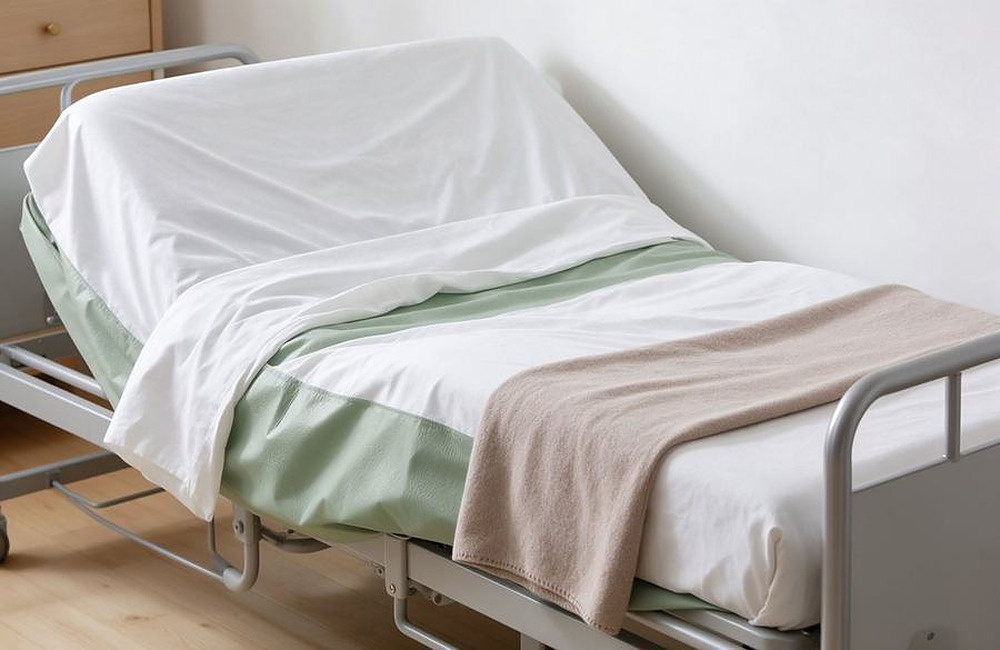
The bed itself, close in: profiling frame, washable cover and a folded blanket. Specification decisions start here, at the mattress surface rather than at the room styling.
On this page
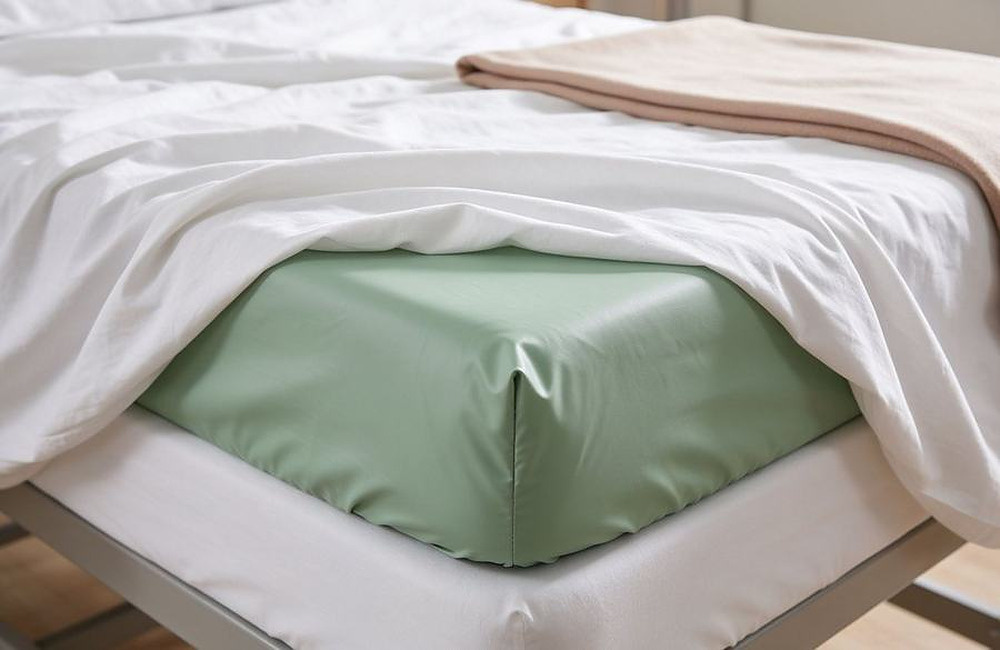
A fitted cover pulled over a 90×200 cm care mattress. The corner elastic and the skirt depth decide whether it stays on during a profiling bed's head raise.
Washable waterproof bedding for nursing homes is bought on cost per resident per year. A disposable pad looks cheaper at the till and often costs more across twelve months of replacement. A 0.025 mm membrane rated for 730 washes carries a different annual figure from a 1.2 mm pad that cracks at 10.
This page compares the two models, states what waterproof has to mean in a contract, and gives the wash limits of laminated fabric before a specification is signed.
So what must a contract actually say before waterproof means anything?
Care home procurement starts from the bed count and the change frequency, not from a product list.
A 120 bed unit changing twice a day consumes a different mix from a 40 bed unit changing once, and the same catalogue page serves both badly.
Start with the arithmetic, then pick the construction that survives it. Then price the laundry loop, not the cover. Colour fastness and water resistance procedures are defined by AATCC. Our production is based in Foshan, Guangdong, China, where cutting, sewing and packing are handled in-house.
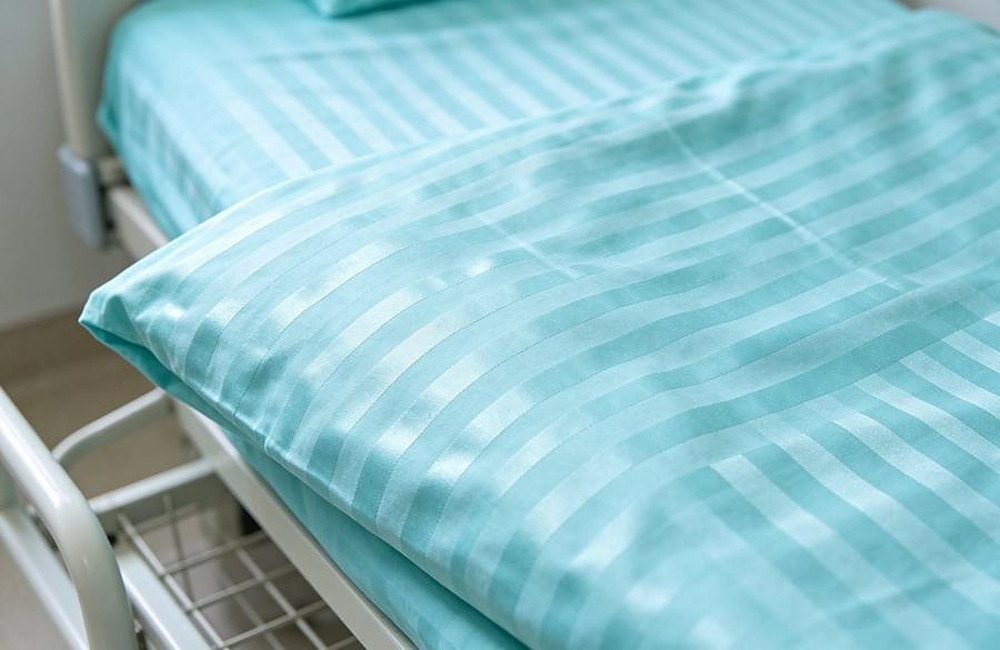
A colourway that hides staining without hiding the barrier underneath, checked against a wet pad on the reverse.
Quick answer: Washable and disposable linen are compared on the wrong unit most of the time. The comparison that decides a care home budget is cost per resident per day: a washable cover at 30 cycles against a disposable at one use, with laundry labour and water counted on the washable side, not only the purchase price.
The unit price is the wrong number. A disposable underpad at EUR 0.40 to 0.60 in bulk looks trivial next to a reusable pad at EUR 3 to 6.
The comparison only becomes honest when both sides are converted to one unit: cost of managing one incontinent resident for one year.
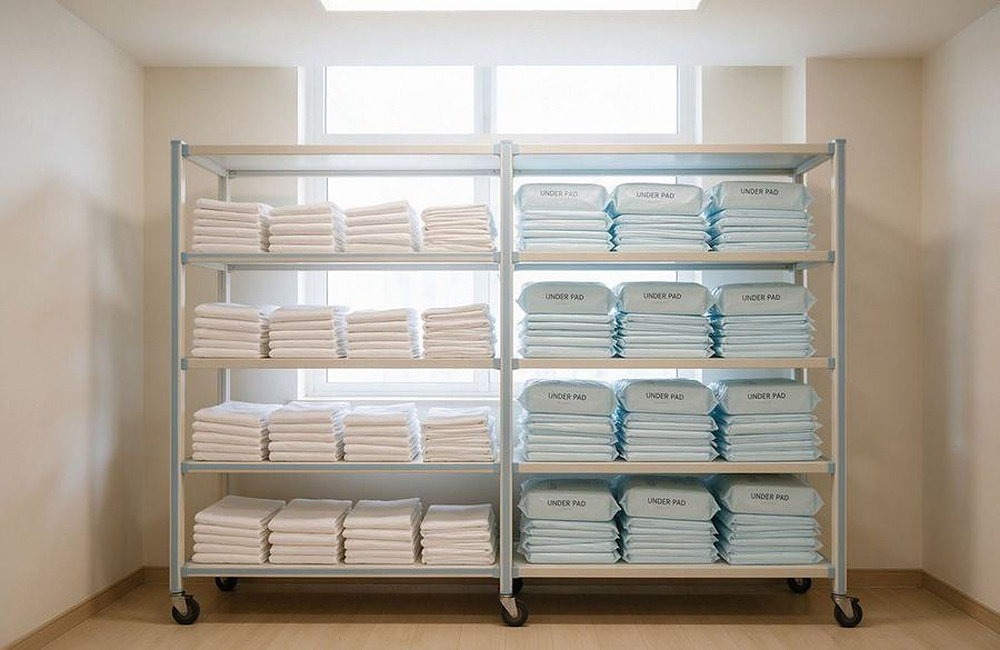
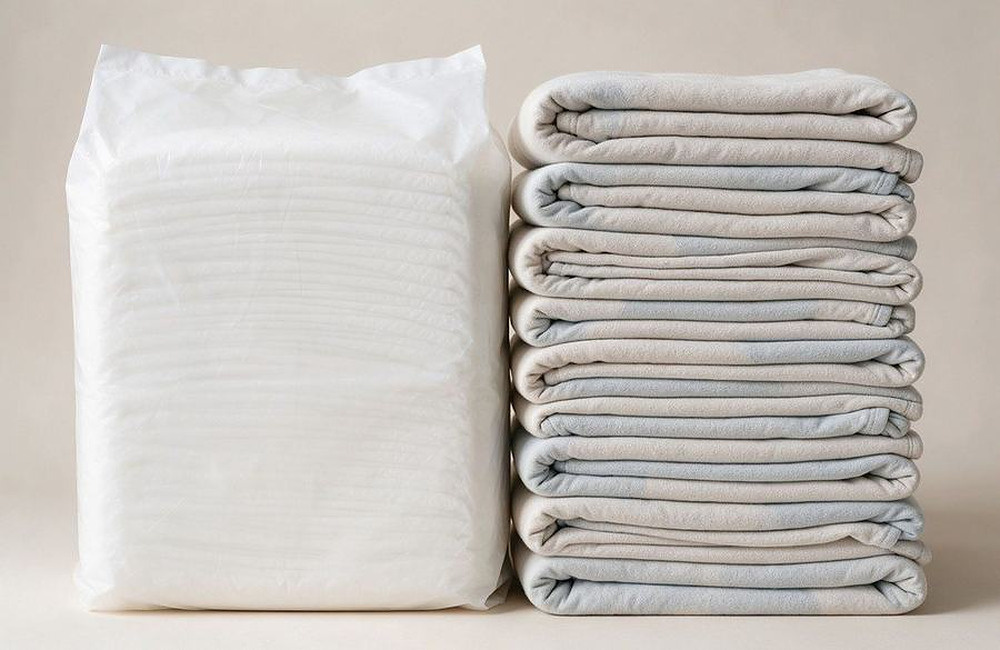
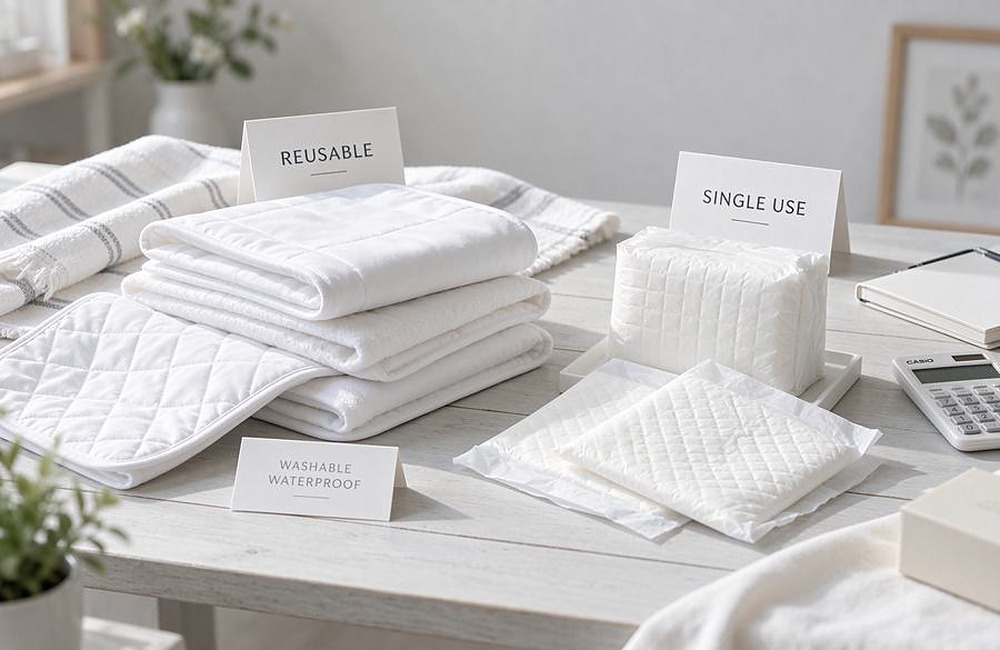
Reusable and disposable stock sit side by side, and the cost figure only makes sense when both are counted.
A care home that switches from disposable to washable does not simply replace one product with another. It replaces a purchase with a laundry loop: collection, wash, dry, fold, return, and the staff hours inside that loop.
The comparison only holds when both columns are counted over the same period. Take the usage pattern that care homes actually report.
A resident with moderate incontinence is changed twice a day on a scheduled round, with extra changes when the pad is wet. That is 730 changes a year at two per day, or close to 1,100 at three.
At EUR 0.50 a disposable pad, one resident costs EUR 365 to 550 a year in pads alone. At the top of the price range, EUR 0.90, the same resident costs EUR 657 to 985.
Now the reusable side. A pad is not replaced at each change; it is washed. Across 148 healthcare facilities studied in a published cost analysis, reusable incontinence pads averaged 29 to 30 laundry cycles before being withdrawn, with a range of 23 to 40.
That figure matters more than any supplier claim, because it sets how many new pads must be bought each year. At 30 cycles, a resident generating 730 changes a year needs roughly 24 new pads annually if every change used a fresh pad.
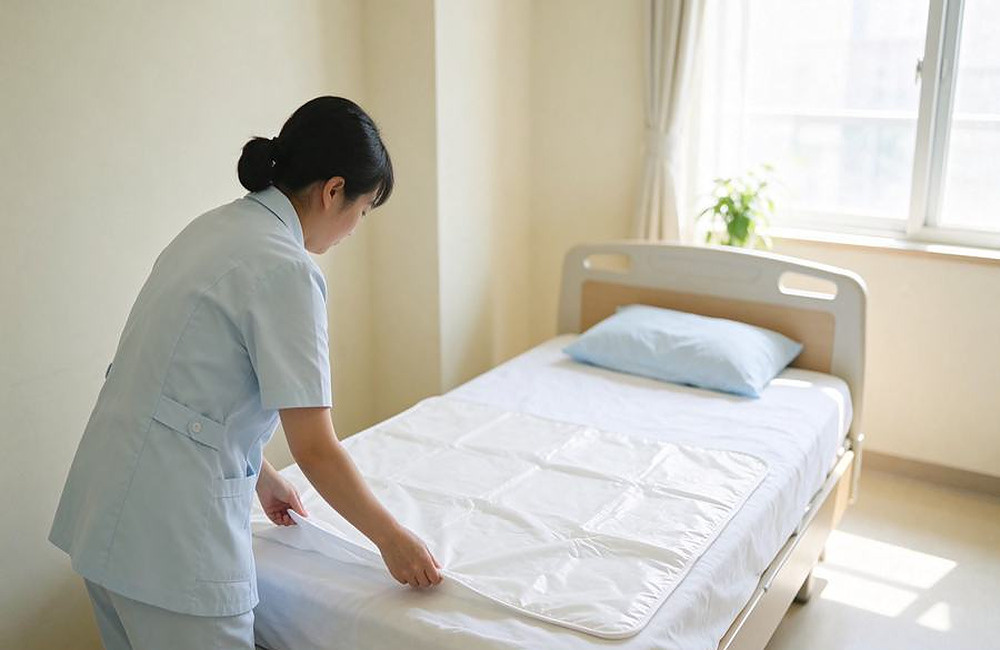
Reusable protection is a procedure, and the procedure is what the care plan buys.
That is the ceiling most quotes hide. A supplier advertising "300 wash cycles" is describing a laboratory wash test on a fabric swatch, not a pad surviving a care home laundry with detergent, heat and mechanical action.
When the same 148-facility study costed the two models on real cycles, reusable pads with laundry processing came out 64 percent cheaper per year than disposables at a one-to-one usage ratio, and 80 percent cheaper at the 2.1-to-1 ratio that reflects how staff actually use them.
In other words, buying disposables costs between 2.8 and 5 times more per year for the same coverage. The second saving is not in the pad at all. A clinical crossover study on 36 incontinent nursing home patients compared disposable pads with a launderable absorbent sheet.
Bed linen changes fell 43 percent per patient per day, from 4.9 to 2.8, and the cost of managing incontinence fell 40 percent, from USD 3.23 to USD 1.98 per patient per day.
Laundry weight also dropped 18 percent, because fewer complete bedding changes were needed. The saving came from not having to strip the whole bed, not from the price of the pad.
The number to put in a business case.
One avoided bed change saves a sheet, a duvet cover in some homes, a laundry cycle and eight to fifteen minutes of staff time. At two avoided changes per resident per day across 60 incontinent residents, that is 120 fewer bed changes daily, and the labour line usually exceeds the material line.
The comparison usually lands on a narrow band. Washable wins on volume above roughly sixty beds and three changes a week, disposable wins when the laundry is outsourced at a high per kilo rate, and mixed use is common.
The point is not which column is cheaper in general, but which is cheaper at this bed count and this laundry.
Quick answer: Waterproof means nothing in a contract unless it is a hydrostatic head figure in mmH2O to AATCC 127, with the test face named, the same figure required after ten industrial washes, and a sealed seam at the stitching. Without those four clauses a supplier passes on a swatch and fails on the cover.
"Waterproof" written on its own is not a specification. It is a word that two suppliers can satisfy with products that behave differently on the first night.
A nursing home contract needs four elements: the test method, the numerical result, the condition of the sample, and the place where the barrier is interrupted.
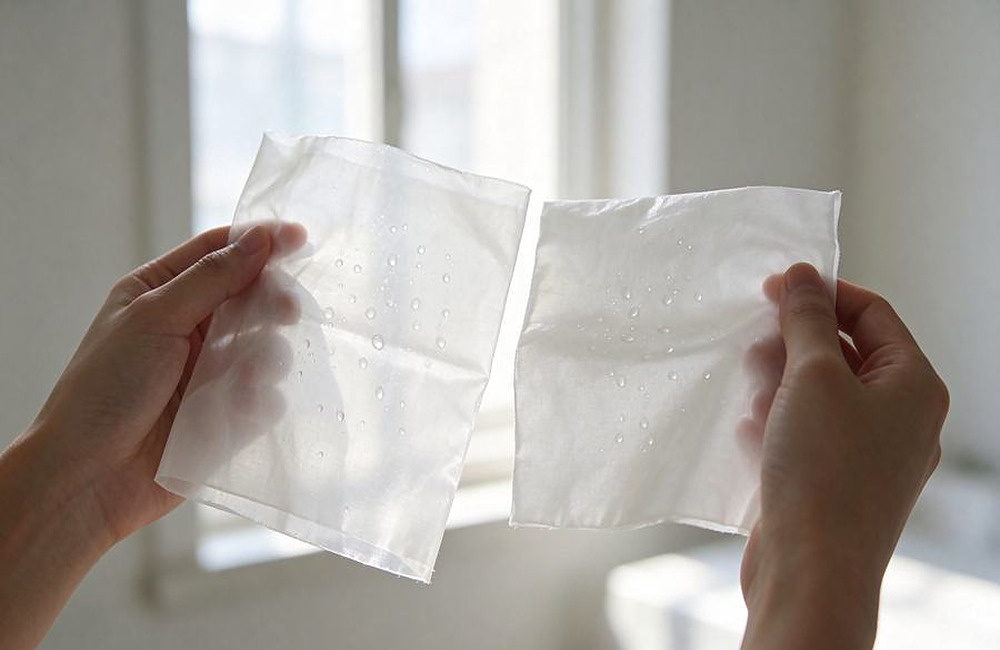
The barrier is the film in the middle, not the face cloth.
Waterproof is a number, not an adjective. A contract that says waterproof without a hydrostatic head, a test method and a wash count can be satisfied by a sheet that stops a spill today and fails at cycle twenty.
Write the head in millimetres, the method, and the cycles the claim survives.
The test method is AATCC 127, hydrostatic pressure resistance; buyers in the UK and the EU usually name the same measurement as ISO 811:2018, which EN 20811 mirrors, and ISO 811 is a method rather than a certificate, so the report carries the head in cmH2O with the rate of rise and the face tested.
A specimen is clamped over a water column and pressure is raised at a controlled rate until water penetrates on the opposite face.
The result is reported in millimetres of water column (mmH2O) or centimetres (cmH2O), and it is meaningless without the rise rate and the face tested.
Ask for the figure in mmH2O, the rise rate in the report, and whether the tested face was the skin side or the mattress side. For incontinence bedding, the working band is 1,000 to 2,000 mmH2O.
Below roughly 500 mmH2O a barrier resists a spill but not sustained pressure, and a resident lying on wet fabric for an hour is exactly the sustained pressure case. Above 2,000 mmH2O the film is usually thick enough that breathability falls sharply, which trades one skin risk for another.
A care home does not need a surgical barrier; it needs a barrier that holds under a body for a full night.
The fourth element is the one that fails most often in service. Laminated fabric is rarely penetrated through the film. It leaks through the stitch line. Sewn seams create needle holes that act as capillaries, and fluid wicks along the thread into the absorbent top layer.
A specification that states hydrostatic head but says nothing about seam construction will pass the lab test and fail in the laundry.
Require seam sealing by heat tape, ultrasonic welding or a welded seam with taped cover, and require the hydrostatic test to be repeated on a seamed specimen, not a flat swatch.
Four things to demand in writing.
Hydrostatic head in mmH2O with the test face named; the same test repeated after 10 industrial washes; seam construction named and tested; and a written statement of what happens to the barrier at the corners, where elastic and stitching meet.
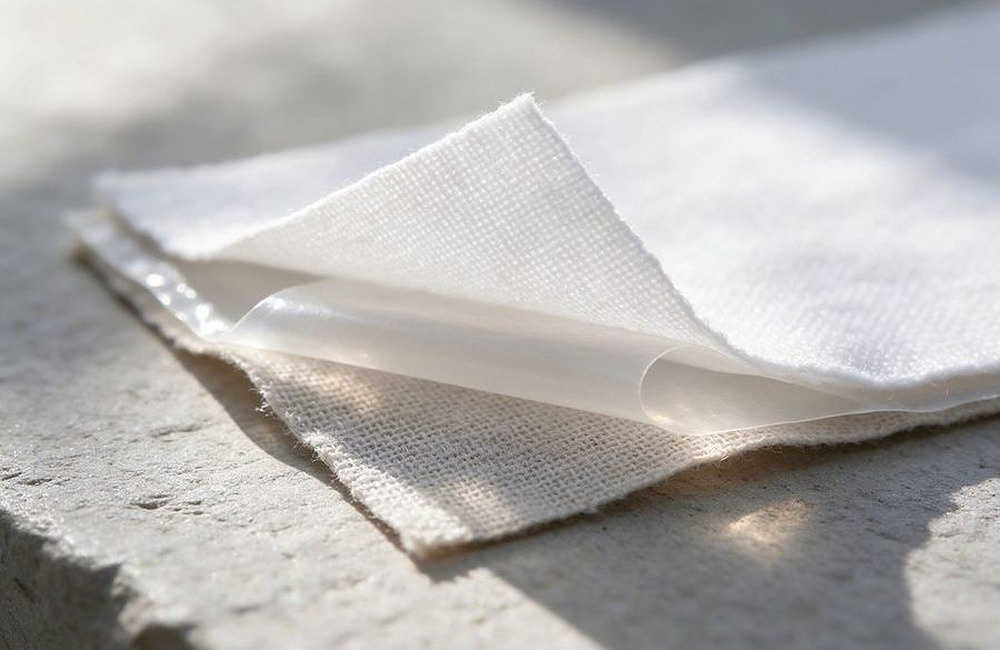
The barrier decision is not which film is best but how much vapour a resident's skin can take for eight hours.
Quick answer: Breathability and barrier are a trade-off, not a pair of independent features. A TPU film at around 0.025 mm gives barrier and moisture vapour transfer; a PVC coating at around 1.2 mm gives a stronger barrier at a lower price but traps heat and moisture, which shows up as skin breakdown in long-stay residents.
Waterproofing and breathability pull in opposite directions. Every millimetre of hydrostatic head is bought with a denser barrier, and a denser barrier moves less moisture vapour. The choice is not which film is "best"; it is how much barrier a resident's skin can tolerate for eight hours.
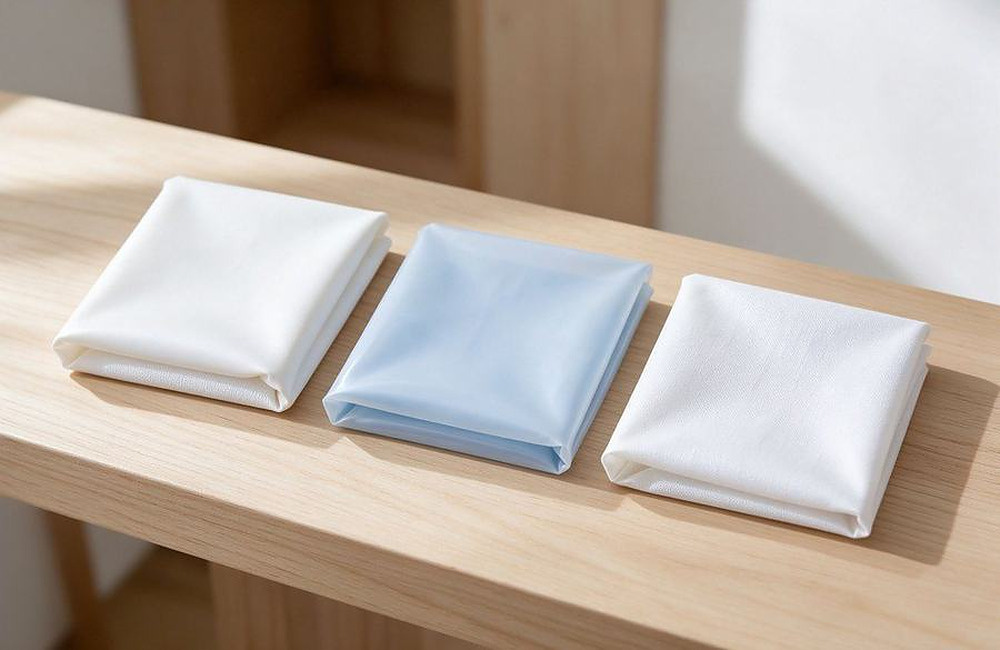
Three barrier constructions, three price points, three wash lives, compared on the same bed frame.
Three constructions reach the same barrier by different routes. A TPU film is soft, quiet and light but costs more per square metre.
PVC holds a higher head at a lower price and is heavier and louder. A coating is the cheapest and the thinnest lived.
The choice follows the wash regime, not the catalogue. Three constructions dominate institutional bedding. A thermoplastic polyurethane film, typically 0.015 to 0.025 mm, laminated to a knit or terry top: high hydrostatic head, soft hand, quiet, and the only one of the three that keeps useful moisture vapour transmission.
A polyvinyl chloride sheet, often 0.8 to 1.2 mm: total barrier, no breathability, audible crease, and heavy. A polyurethane coating applied directly to the fabric back: cheaper than a film, thinner, and the first to crack at fold lines after repeated industrial washing.
Breathability is measured two ways and they are not interchangeable. ISO 9237 gives air permeability in mm/s, which describes airflow through the fabric. ISO 15496 and the cup methods give moisture vapour transmission in g/m2/24h, which describes how much sweat vapour escapes.
A pad can be air-permeable and still trap vapour if the film is solid; the number a care home should ask for is the moisture vapour figure, measured after washing, not the air permeability of the face fabric.
One correction is needed here because it appears in almost every supplier brochure: breathability does not prevent pressure ulcers. Pressure ulcers come from pressure and shear over a bony prominence, and no bedding film changes that.
What breathability affects is the moisture-related damage that sits alongside it, incontinence-associated dermatitis, where wet skin plus friction breaks down the skin barrier.
A breathable barrier reduces that risk; it does not replace repositioning, a pressure-redistribution mattress or a skin inspection routine. Any supplier claiming otherwise is selling past the evidence.
|
Construction |
Barrier (AATCC 127) |
Moisture vapour |
Hand and noise |
Where it fails |
|
TPU film 0.02 mm + knit top |
1,000–2,000 mmH2O |
Useful; ask for g/m2/24h after washing |
Soft, low noise |
Delamination at the laminate edge; heat damage above 90 °C |
|
PVC sheet 1.0 mm |
Very high, well above 2,000 mmH2O |
Minimal |
Stiff, audible crease |
Cracks at fold lines; plasticiser migration over years |
|
PU coating on back |
600–1,200 mmH2O |
Moderate when new |
Dry hand, quiet |
Micro-cracks after 20–30 industrial washes |
|
PUL knit (polyurethane laminated) |
1,000–1,500 mmH2O |
Good for a knit barrier |
Stretch, soft |
Stretch recovery loss; barrier thinning at high-stretch zones |
Choose the barrier by the wash regime first, then by the feel the nursing staff want. A care home with its own tunnel washer can carry a coating and replace it sooner; one sending linen out weekly needs a film that survives the transport and the cycle count.
Price per square metre is the third question, not the first. Barrier first, then price per square metre.
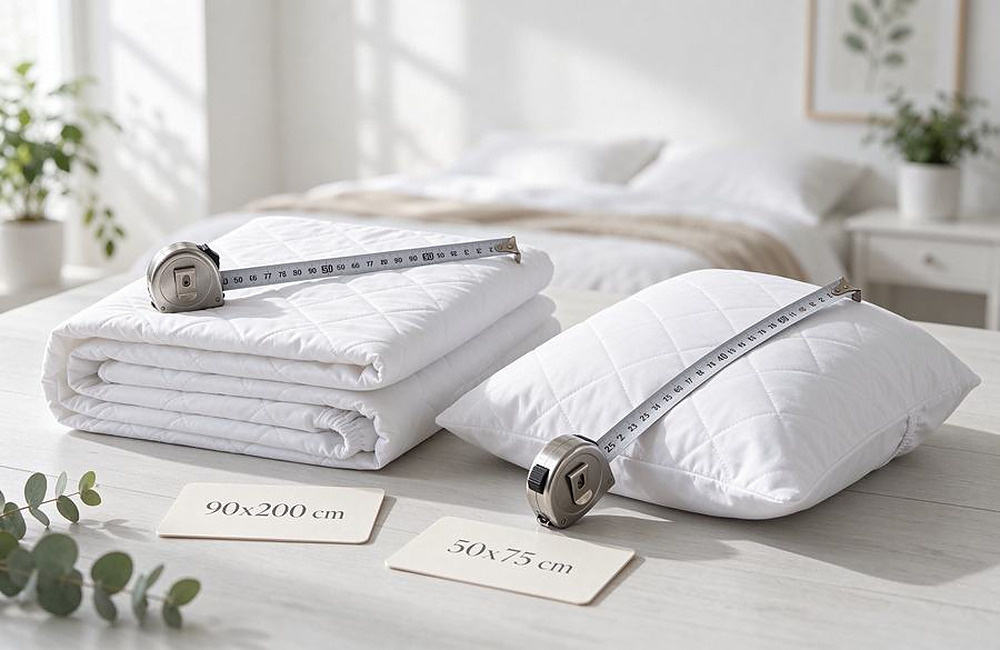
Film thickness side by side: a thin TPU laminate next to a thick PVC sheet. The thicker barrier wins on hydrostatic head and loses on moisture vapour, which is the trade this section describes.
Quick answer: The wash-life ceiling of a laminate is set by the bond, not the base cloth. In care-home use the observed range is 23 to 40 cycles before the laminate fails at a fold or seam, so build the stock plan on that figure rather than the 200 to 300 cycles quoted for an unbonded laboratory swatch.
Every laminated barrier has a finite life, and the number is lower than most catalogues state. The published 148-facility study put the real average at 29 to 30 industrial cycles before withdrawal, with 23 to 40 as the observed range.
That is the figure to design a stock plan around, not the 200 to 300 cycles quoted in product pages, which usually describe a wash test on an unbonded swatch. The test standard matters as much as the result.
ISO 15797 is the industrial wash procedure for workwear and institutional textiles, and it has two methods: method 4 for 50 cycles and method 6 for 100 cycles.
A supplier writing "ISO 15797 tested" without naming the method has told you nothing, because 50 and 100 cycles are different claims.
Ask for the method number, the wash temperature, and whether the barrier was re-tested for hydrostatic head at the end, not only inspected for visible damage. For the adjacent buying decision, see healthcare linen durability standards.
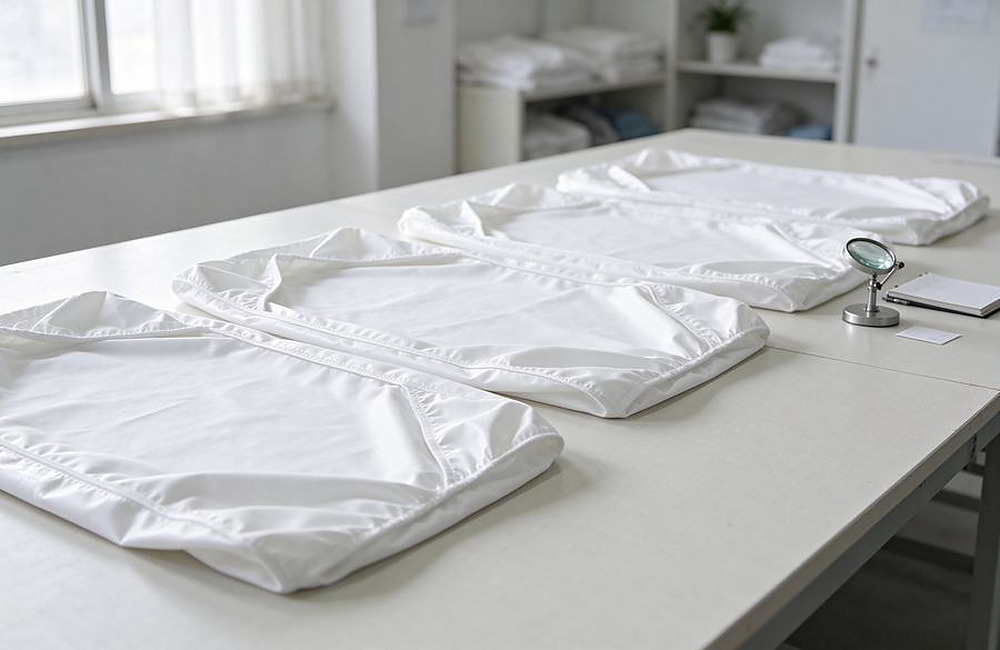
Four covers, not one: a single pass tells you the laminate was good that day, four tell you the process is controlled.
The failure sequence in a care home laundry is predictable. First the top fabric shows pilling and the surface softens. Then the laminate edge, where film meets knit, begins to lift, usually within the first 15 to 25 cycles at 75 to 85 °C.
Then the seam tape or weld line opens at the corners, which is where mechanical stress concentrates during a profiling bed's head raise. Only after those two stages does the film itself fail.
A cover returned as "leaking" has almost always failed at an edge or a seam, not through the middle of the film.
Chemistry accelerates all three stages. Chlorine bleach attacks polyurethane and shortens film life sharply; peroxide and peracetic acid systems are gentler on PU but harder on some dyes.
Wash temperatures above 90 °C improve disinfection and reduce barrier life at the same time, so the disinfection programme and the textile specification have to be agreed together.
A care home that runs an 85 °C main wash with a chlorine-based bleach and a 100-cycle expectation is specifying a product that does not exist at a workable price.
A contract clause that works.
State the acceptance criteria by cycle: hydrostatic head not below 800 mmH2O after 25 industrial washes at the agreed temperature, and no delamination at the laminate edge. Test four covers, not one. A single sample passing tells you the laminate was good that day; four samples tell you whether the process is controlled.
Laminated fabric does not fail gradually. It passes the hydrostatic test, then one wash cycle later it does not, and the failure is invisible until a mattress is wet.
That is why the wash life ceiling belongs in the purchase order as a number of cycles, and why the sample has to be tested after washing rather than before.
Test the washed sample, always.
Quick answer: The incontinence kit is three items, not one: a mattress cover with a barrier at the seam, a washable pad for the bed, and a pillow cover with the same barrier. Each carries its own wash requirement, and specifying only the mattress cover leaves the two highest-contact surfaces unprotected.
A single waterproof cover is not a system.
Care homes that buy only a cover end up washing it every day, which is the fastest way to reach the 25-cycle delamination point.
The workable unit is three pieces used at different frequencies, so that the barrier that touches fluid most often is the cheapest piece to replace. The fitted cover sits on the mattress and is changed weekly, or whenever it is contaminated.
The absorbent pad sits on top of the sheet or on top of the cover and is changed at each incontinence event; it takes the fluid load and most of the washing.
The pillow protector covers the pillow and is changed with the cover, because face and hair contact is a separate contamination route that a bed pad does nothing about.
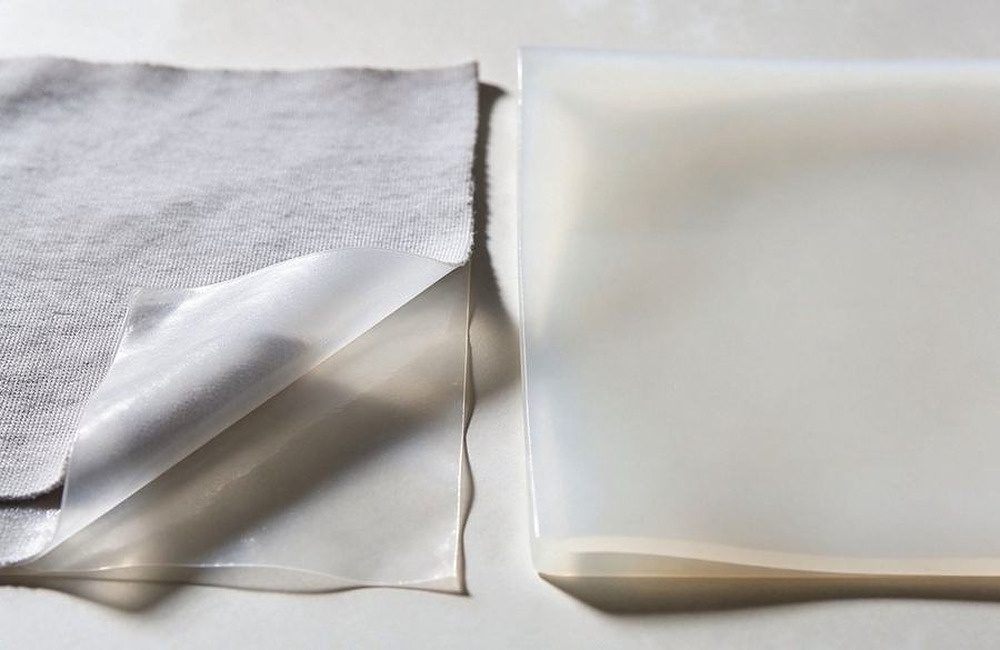
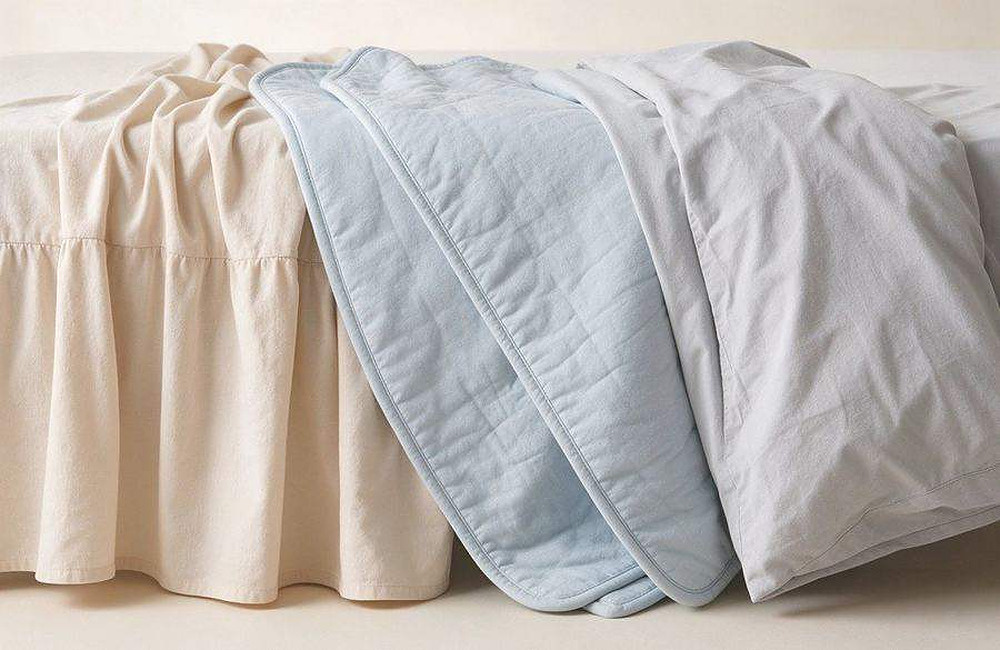
Cover and pillowcase are ordered as a pair, and both sizes belong on the same purchase order line.
Pairing the three changes the wash economics completely. If 75 percent of pad returns are unsoiled, as the 148-facility field data showed, most pads can be returned to the bed without a wash cycle at all.
The cover, by contrast, is washed on a schedule regardless. Putting the wear on the cheap pad and the barrier on the long-life cover is what keeps the annual replacement line low.
|
Product |
Construction |
Hydrostatic head (AATCC 127) |
Breathability |
Wash cycles |
Size / MOQ band |
|
Fitted waterproof cover |
Knitted polyester top + TPU film + skirt |
1,500 mmH2O |
Moisture vapour tested after 10 washes |
25–40 industrial |
90×200, 100×210, 120×200 cm; 20–30 cm skirt / By size, from small trial lots |
|
Absorbent bed pad |
4-layer: knit face, absorbent core, TPU barrier, grip base |
1,000 mmH2O |
Face fabric air-permeable; barrier solid |
25–35 industrial |
60×90, 75×90, 80×140 cm / By size and colour |
|
Pillow protector |
Knitted top + TPU film, zip or envelope closure |
1,200 mmH2O |
Moderate |
30–40 industrial |
50×75, 51×91 cm / Pairs with cover orders |
|
Flat waterproof sheet |
Polyester top + PU coating, tuck-in |
600–1,000 mmH2O |
Moderate when new |
20–30 industrial |
90×200, 100×210 cm / Volume only |
|
Waterproof pillowcase, envelope |
Cotton-rich top + PU coating |
800 mmH2O |
Moderate |
25–35 industrial |
50×75 cm / Pairs with cover orders |
The kit works as three parts or not at all. A cover alone leaves the pad to slide; a pad alone leaves the mattress exposed at the edges; a pillow protector is the part buyers forget and the part that decides whether a pillow is replaced in year one.
Specify all three, with the same wash count behind each. Same cycle count, all three parts.
Quick answer: Odour and stain behaviour is decided before the wash, not by the detergent. A pre-wash that removes urea and body fluids before the main cycle is what keeps a barrier fabric from holding odour after 20 cycles; skipping it is why some covers are replaced for smell long before the laminate fails.
Urine odour is not solved by washing harder. Urea breaks down into ammonia, and ammonia is alkaline; washing an alkaline load in an alkaline detergent locks the odour into the fibre instead of releasing it.
The correction is a short acidic pre-wash at pH 5 to 6, at 35 to 40 °C, before the main wash. That step converts the ammonia salts back into a soluble form that the main wash can carry away.
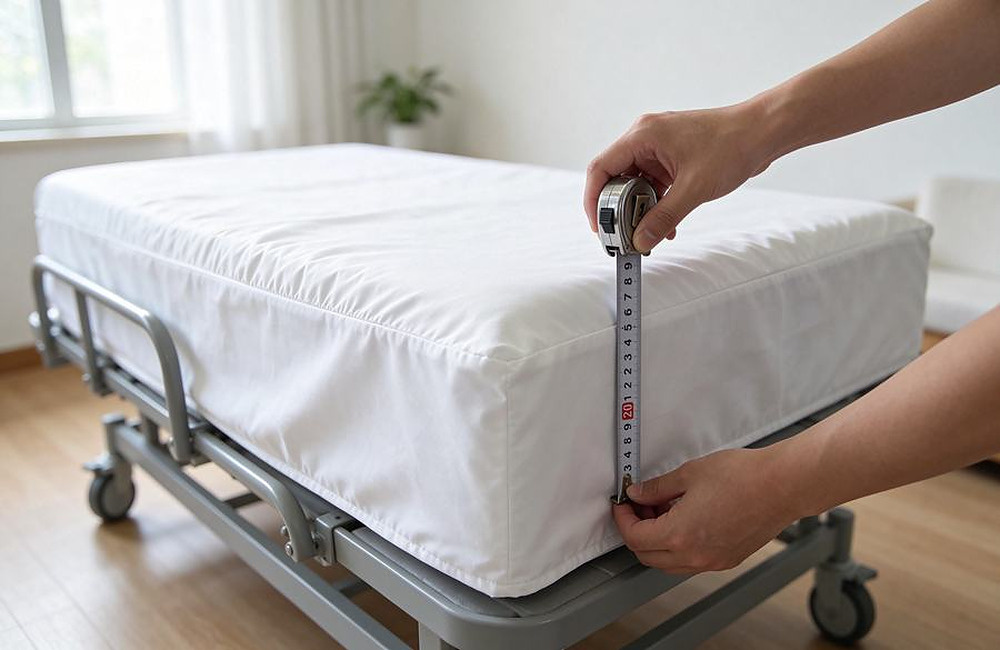
Stain treatment before the wash decides whether the mark survives fifty cycles.
Odour and stain are decided before the drum, not inside it. A care sheet that arrives at the laundry with urine left to settle needs a different pre-treatment from one rinsed at the bedside.
Standardise the pre-wash step, then the wash programme, then the drying temperature, and record what each step is meant to remove. The industrial laundering and dimensional change methods behind every figure here are set out in the ISO textile standards.
Temperature has to be split from chemistry. A main wash at 70 to 85 °C with a chlorine bleach disinfects effectively and destroys polyurethane at the same time.
A main wash at 70 °C with a peroxide or peracetic acid system disinfects to a comparable level and leaves the film intact for longer.
Where the local infection-control policy demands chlorine, the barrier should be specified for a shorter life and the replacement line in the cost model should be raised accordingly, rather than assuming the standard life figure. Stains need the pre-wash stage to do the work.
Protein stains from faeces and blood set permanently above 60 °C, so a pre-wash at 40 °C with an enzymatic detergent, by a cold rinse, removes more than any increase in main wash temperature.
Rubbing the stain before washing spreads it into the absorbent core and makes the pad look worn out early, which is the most common cause of pads being withdrawn before their cycle limit.
Residue is the last variable and the one residents feel. Detergent residue above pH 8 on a dried cover irritates skin on contact, and chlorine residue does the same.
A final rinse with a weak acid neutraliser brings the fabric back to skin-compatible pH and removes the last of the alkali.
This is a laundry step, not a textile specification, so it belongs in the contract with the laundry provider rather than with the bedding supplier.
The skirt is specified against the real mattress, never against the platform size the bed was bought at.
Quick answer: Care bed sizes run 200 and 210 cm in length, with pocket depths of 20, 30, 14 and 15 cm depending on the frame. A profiling or adjustable bed changes the effective mattress depth as it articulates, so the skirt has to be specified against the raised position, not the flat one.
Care beds are not hotel beds with a different name. The standard profiling platform in European care is 90×200 cm, with 100×210 cm used for heavier residents and bariatric frames, and 80×200 cm for paediatric or small-frame beds.
A cover sized for 90×200 cm will not fit a 100×210 cm platform, and a cover sized for both will be loose on the smaller one, which is where the corner lifts. Adjustable frames change the geometry more than the dimensions suggest.
When the head section raises to 30 degrees, the mattress surface shortens along the top by roughly 2 to 4 percent and the cover has to absorb that movement.
A fitted cover with a skirt of 20 cm and four-corner elastic handles a 30-degree raise; a cover with a 30 cm skirt and elastic only at two corners will lift at the foot end.
Ask for the skirt depth, the number of elastic anchor points, and whether the cover was tested on a raised platform rather than a flat one. Mattress thickness is the third dimension nobody quotes.
Care mattresses run from 14 cm foam to 20 cm alternating-pressure or air systems, and a cover made for a 15 cm mattress will gap on a 20 cm one.
The skirt must be specified against the actual mattress, not against the platform size, and the two figures should be written separately in the purchase order.
Care bed dimensions change more often than hotel dimensions, because frames are adjusted and mattresses replaced. Measure the actual deck with the frame in its raised position, then add the pocket depth for the inflated mattress.
A cover that fits a flat 90 by 200 deck will not fit the same deck at 30 degrees. Measure twice, and write the deck height down.
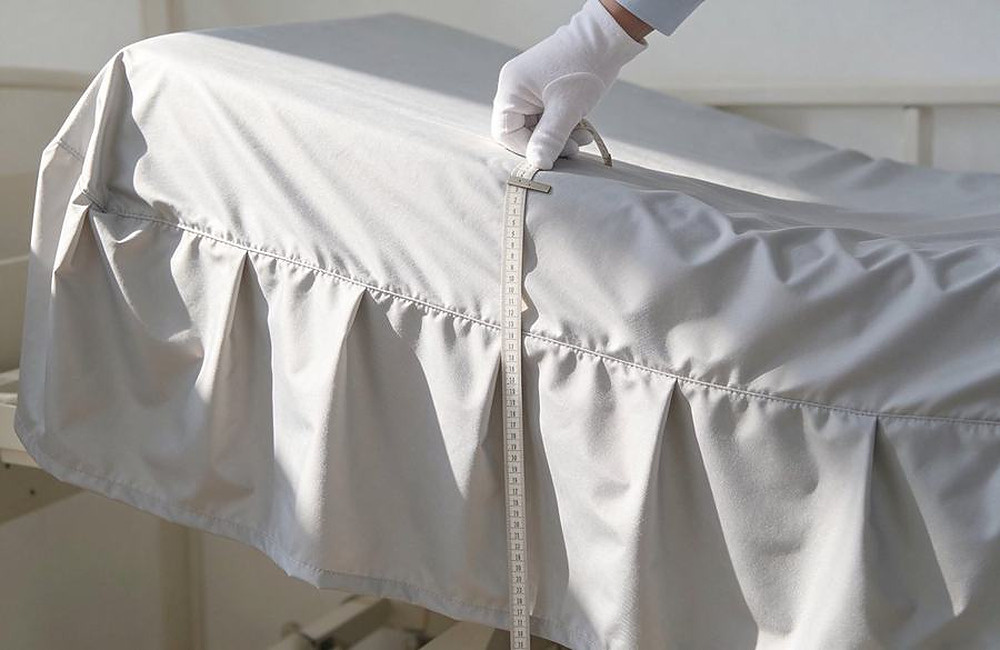
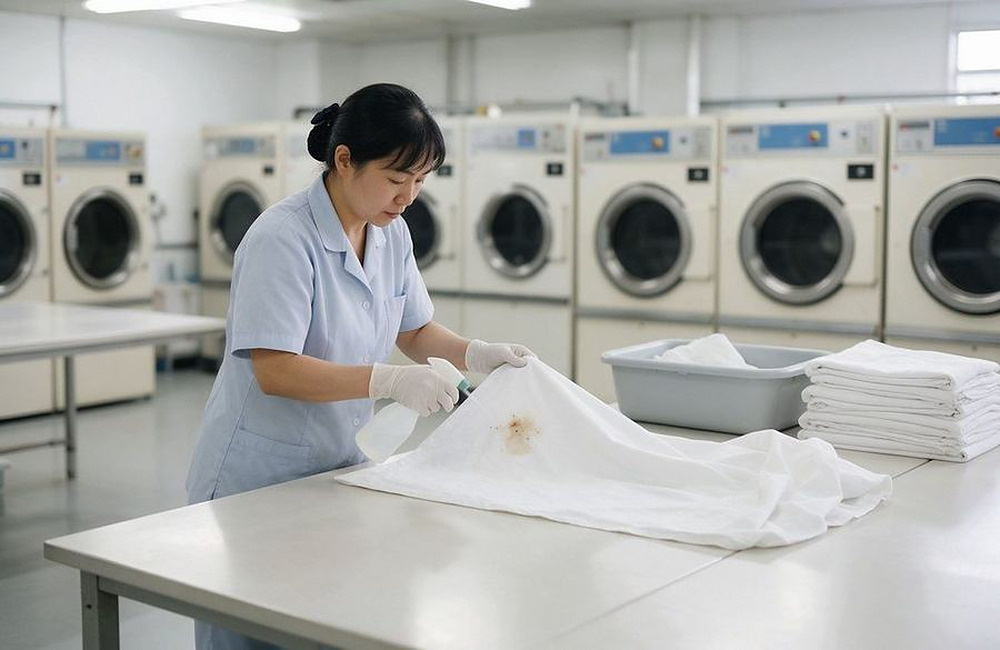
Measuring a raised head section against the cover: the surface shortens when the platform profiles, and the skirt has to absorb the difference.
Quick answer: The annual cost model is a function of cycles, not of price. Divide the annual wash count per resident by the wash-life ceiling the laminate actually reaches, multiply by the unit cost, and add the laundry labour — that number, not the catalogue price, is what a procurement committee compares.
Three lines make the model, and most quotes only give you the first. The replacement line is the number of pieces withdrawn per year divided by the real cycle count. The laundry line is the number of wash cycles per year multiplied by the cost per cycle.
The labour line is the change time saved or added, which is where the disposable model quietly loses. A fourth line, clinical outcome, is usually left out and should not be.
An annual cost model for a care home has four lines, not one: the cover, the pad, the pillow protector and the laundry. Run it off the actual bed count and the actual change frequency, then add the replacement rate the wash cycles imply.
A model built on list prices alone will be wrong by the second quarter. For the adjacent buying decision, see institutional bedding procurement.
The stock calculation follows the same pattern used for hotel linen. Total stock equals the number of beds, times pieces per bed, times the par factor, times a buffer.
For incontinence bedding the par factor is lower than for hotel towels, because pads are washed within the day rather than held for a two-day turnaround.
A par of 3 and a buffer of 20 percent is a workable starting point for a home with its own laundry; a home using an external laundry should plan 3 to 4 par and a 30 percent buffer.
Worked example on 100 beds. Assume 65 residents with incontinence, two changes a day, 30 real cycles, and one pad per change. Annual changes are 47,450. Disposable pads at EUR 0.50 give EUR 23,725 in materials.
Reusable pads: 47,450 changes divided by 30 cycles means about 1,580 new pads a year at EUR 4, which is EUR 6,320; plus 25 percent of returns actually washed, 11,860 cycles at EUR 0.35, which is EUR 4,150; plus covers replaced on a 35-cycle basis.
The reusable material and laundry total lands near EUR 10,500 against EUR 23,700, before any labour saving.
Every assumption in that model should be written into the tender so that bidders cost the same scenario rather than their own.
The four assumptions that decide the answer.
Incontinence rate, changes per resident per day, real cycle count, and the share of returns that actually need washing. Change the cycle count from 30 to 60 and the replacement line halves; change the wash share from 25 to 100 percent and the laundry line quadruples. Bidders who will not state these four figures are not giving you a comparable price.
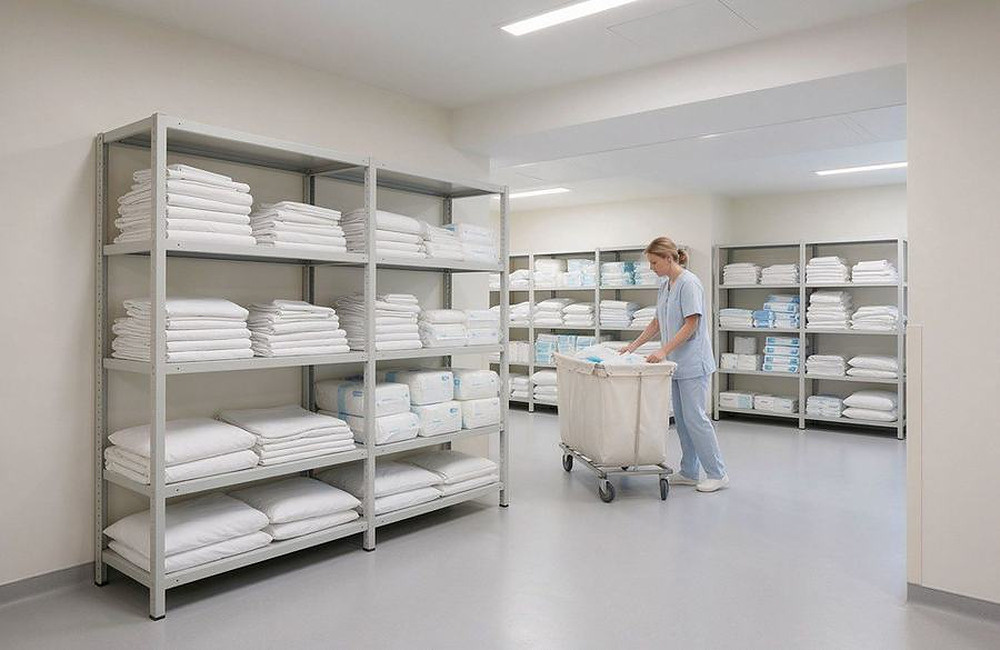
Annual cost starts with an accurate count of what is on the shelf.
Quick answer: Compliance in this category is about flammability and labelling as much as barrier performance, and the requirements differ by market. A cover that meets a barrier standard but not the local flammability requirement for a care setting is not compliant, however well it performs in the wash.
Two different regimes apply and they are often confused.
Product safety for skin contact is GB 18401 class B for direct skin contact, with OEKO-TEX Standard 100 as the voluntary chemical-safety certificate and REACH compliance for the EU market.
Flammability is a separate requirement that sits with the mattress and the mattress pad, not with the sheet.
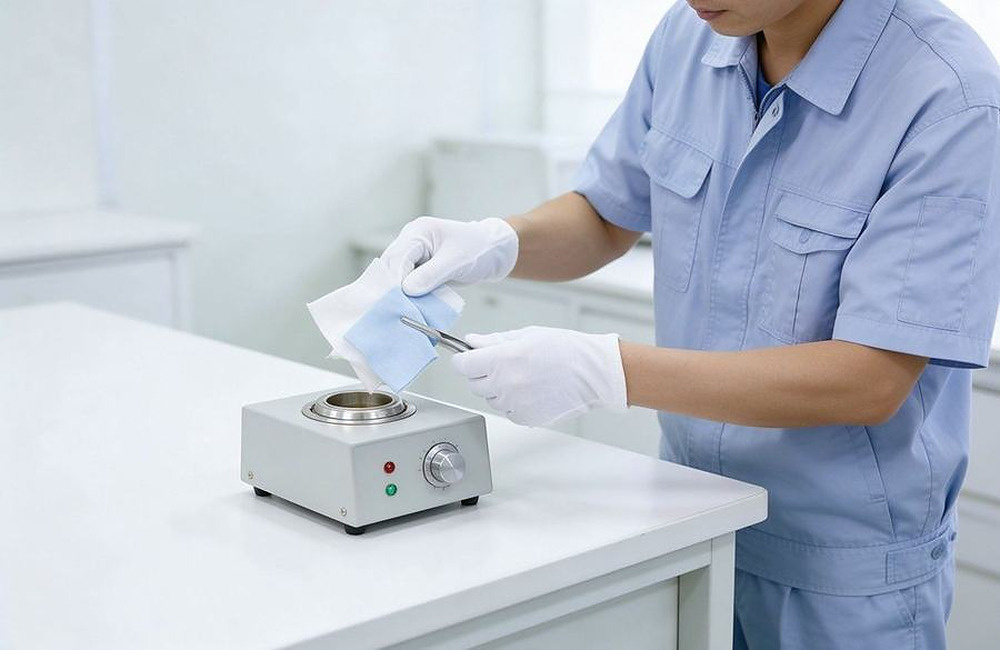
Which method, which component, after how many washes: the class alone says nothing.
Flammability is the one requirement a buyer cannot test in the sample room.
Ask which test method was run, on which component, and at what wash cycle, then keep the report reference in the specification.
The class alone tells you nothing, because a cover and a mattress protector are not assessed the same way. In the UK, BS 7177:2008+A1:2011 covers resistance to ignition of mattresses, mattress pads, divans and bed bases, and sets four hazard classes: low, medium, high and very high.
Because a mattress protector is a mattress pad in the wording of the standard, a UK care home tender can legitimately require a BS 7177:2008+A1:2011 class for the cover itself. Care homes typically specify medium or high depending on the resident profile.
Other markets apply cigarette-ignition and open-flame rules to mattress sets; a protector supplied with a compliant mattress set inherits part of that test position, but it does not replace it. In Europe, BS EN 597 covers ignitability of mattresses and foundations.
A care bed changes the geometry before any size is chosen. The deck articulates, the head section lifts and the mattress compresses under the knee break, so the sheet needs more length and a wider pocket than the same nominal size on a flat bed.
Specify the bed, then the size.
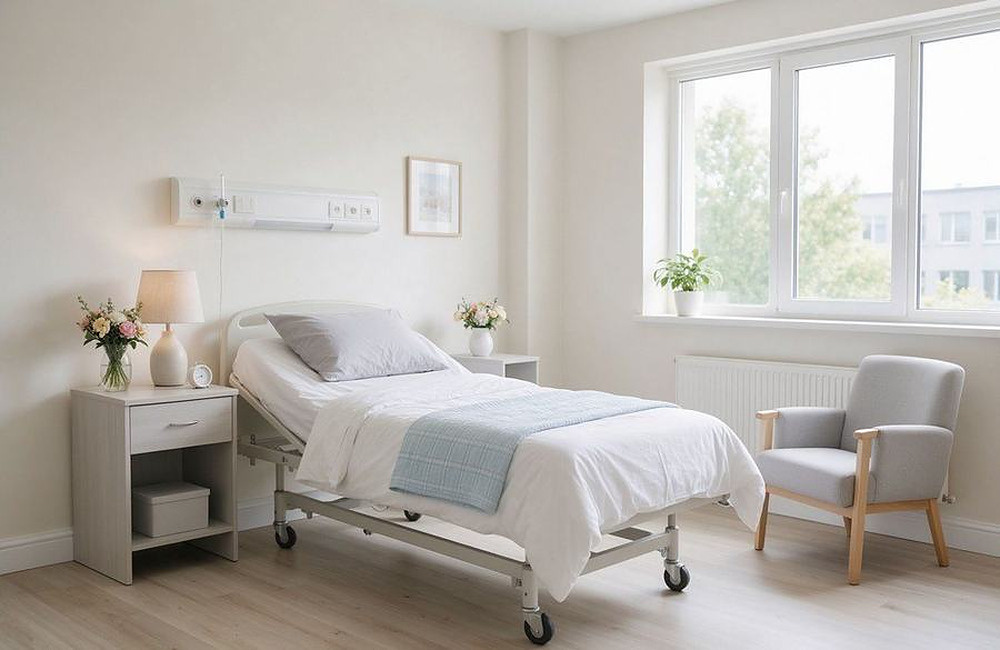
The deck articulates: the same nominal size needs more length and a wider pocket here.
Two standards that do not apply, and one certificate that does not exist.
BS 5867-2:2008 is a curtain and drape flammability standard; it does not cover bedding, and a supplier quoting it for a mattress protector has the wrong document. EN 14065 is a laundry quality management system (RABC), not a product certificate. And CE marking does not apply to ordinary textiles; a "CE certified" claim on a mattress protector is not a valid statement for this product category.
Ask for certificates with numbers, not logos. An OEKO-TEX certificate has a number and a validity date and names the article; a certificate number that cannot be checked on the issuing body's database is not evidence.
For GB 18401, ask for the test report naming the class and the test items, because the class alone does not tell you which tests were run.
Compliance in this category is about fire performance and about claims. A care home in most European markets will ask for the flammability evidence behind the textile, and a supplier who cannot match the product to the standard being cited is describing a different product.
Keep the test report attached to the batch, not to the catalogue. A report dated three years ago may already be superseded.
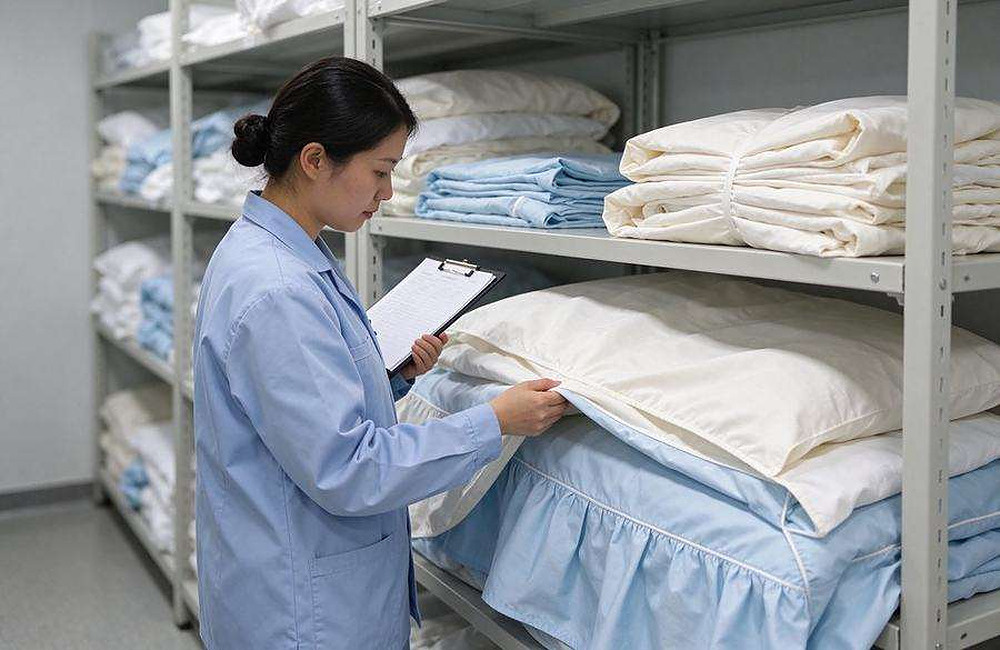
Quick answer: Six tests belong on a sample before an order: hydrostatic head to AATCC 127 on the finished cover, the same figure after ten washes, seam integrity under pressure, dimensional change after five washes, colour fastness to washing and to urine, and a laminate adhesion check at the fold line.
Before a trial order becomes a contract, six checks on one physical sample settle most of the risk. None of them needs laboratory equipment, and all of them should be done on a seamed cover, not on a cut swatch.

A number on a test report only means something with the test method beside it.
Six tests on a sample answer more than a specification sheet. Hydrostatic head, seam leakage, wash shrinkage, barrier after twenty five cycles, surface drying time and noise under a body.
Run them in that order, and reject on the first failure rather than the average, because the average hides the seam.
One: the pour test. Lay the cover flat on a dark surface, pour 200 ml of water into the centre, and leave it for 30 minutes. Look under the cover, not on top.
A barrier that passes AATCC 127 at 1,500 mmH2O will show nothing; a barrier that leaks at the laminate edge will show a damp ring within ten minutes.
Two: the seam test. Pour water directly along a stitched seam and along a corner where the skirt meets the top. This is where service failures start, and a flat-swatch certificate will not predict it.
Three: the fold test. Fold the cover along the same line twenty times, then repeat the pour test on that fold. Coated fabrics crack at fold lines first; films usually survive.
Four: the wash test. Put the sample through ten industrial washes at the temperature your laundry actually uses, then repeat tests one to three. A barrier that changes behaviour after ten cycles will not reach twenty-five.
Five: the breath test. Hold the fabric over your mouth and breathe through it for a minute. It is crude, but a solid PVC sheet and a TPU film are unmistakable, and it tells you within a minute whether the product matches the construction claimed on the data sheet.
Six: the frame test. Fit the sample to an actual profiling bed, raise the head to 30 degrees, and check the foot end and the corners.
A cover that gaps at 30 degrees will gap in service every night. For the adjacent buying decision, see nursing and institutional tender specs.
Six tests cost a day in a laboratory and prevent a year of complaints. The order matters: reject on hydrostatic head before spending time on noise, and reject on seam leakage before measuring shrinkage, because a seam failure cannot be corrected after the goods ship.
Record the cycle count beside every result. A result without a cycle count is a number without a unit. Foshan Yiroufang Textile Manufacture Co., Ltd | Washable waterproof bedding for care homes | Foshan, Guangdong, China
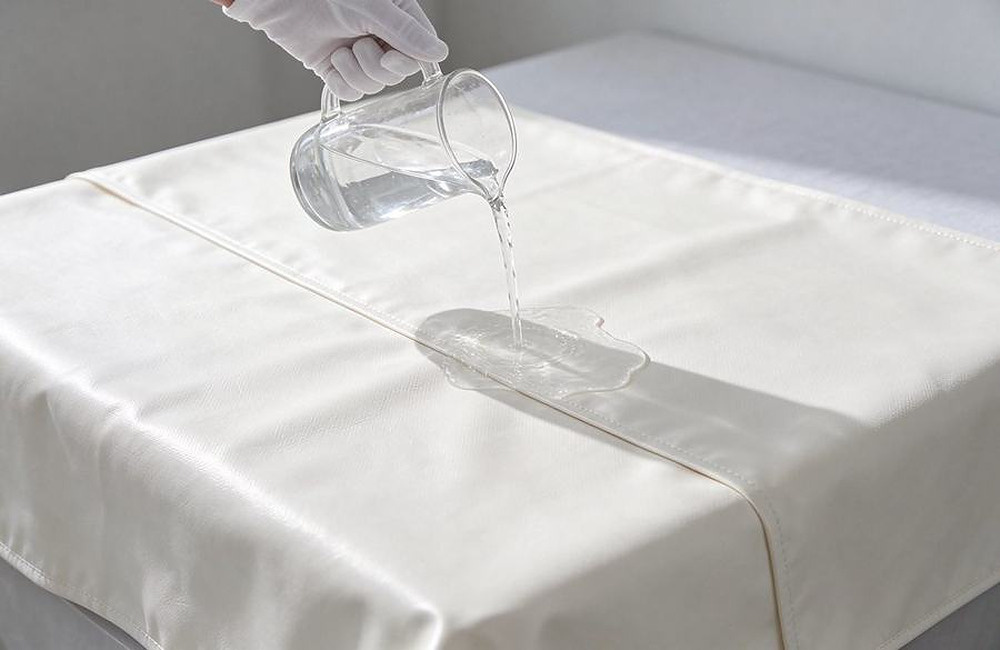
The pour test on a seamed cover: water in the centre, inspection underneath, and a second pour along the stitch line where service leaks actually begin.
Write to lisa@yrftextile.com with the room count and the specification sheet; the reply comes back with finished sizes and the report references. Send the bed size, the mattress thickness, the incontinence rate and the wash temperature your laundry runs.
We will return a construction recommendation with the hydrostatic head and cycle figures for that wash regime, a per-resident annual cost using your four assumptions, and a sample pack with a seamed cover rather than a swatch.
Washable or disposable, which is cheaper per resident?
Washable, on every published comparison that uses real cycle counts. Across 148 facilities, reusable pads cost 64 percent less per year at a one-to-one usage ratio and 80 percent less at the 2.1-to-1 ratio staff actually work at. The saving depends on the laundry being able to process the volume within the day.
What exactly does waterproof mean in your spec?
It means a hydrostatic head figure in mmH2O measured to AATCC 127, with the test face named, plus the same figure after ten industrial washes, plus a sealed seam. For care bedding the working band is 1,000 to 2,000 mmH2O. A number without a test method is a marketing word.
How many industrial washes will the laminated fabric survive?
Plan on 25 to 40, with 29 to 30 as the realistic average from published field data. A 200 or 300 cycle claim usually describes a swatch wash test with no seams, no elastic and no profiling-bed stress.
Do you make fitted sheets for adjustable care beds?
Yes, for 90×200, 100×210 and 120×200 cm platforms with skirts from 20 to 30 cm and four-corner elastic. Give us the mattress thickness as well as the platform size, because the skirt is set by the mattress, not the frame.
Is the fabric breathable enough to prevent pressure issues?
Breathability reduces moisture-related skin damage; it does not prevent pressure ulcers, which come from pressure and shear. A breathable barrier is one part of a prevention routine that includes repositioning and a pressure-redistribution surface.
Can we order a sample pack before committing?
Yes. Specify a seamed cover in the sample, not a cut swatch, so tests two to four on this page can actually be run. A pack with three constructions is more useful than three colours of the same one.
What hydrostatic head should we specify for a care home?
1,000 mmH2O is the floor for sustained body pressure; 1,500 is a reasonable institutional target; above 2,000 the film is usually thick enough that moisture vapour transmission falls and skin exposure rises.
Will the cover survive chlorine bleach?
Not for long. Chlorine attacks polyurethane and shortens the usable life well below 25 cycles. If your infection-control policy requires chlorine, specify a shorter replacement interval and cost it in, or move the main wash to a peroxide or peracetic acid system.
How many covers do we need per bed?
Three in rotation is workable with an on-site laundry, four with an external laundry. Covers are washed on a schedule rather than at every event, so the count is driven by turnaround time, not by incontinence rate.
Do you supply pillow protectors as well?
Yes, in 50×75 and 51×91 cm, with envelope or zip closure. Pillow contact is a separate contamination route from the bed surface and should be specified with the cover, not added later.
Which certificates do institutional bids usually ask for?
GB 18401 class B test reports, OEKO-TEX Standard 100 with certificate number and article, and REACH statements for the EU. Flammability documentation follows the market: BS 7177:2008+A1:2011 class for the UK, and the national rule of the destination market elsewhere. CE marking is not applicable to this product category.
How do you handle odour?
An acidic pre-wash at pH 5 to 6 and 35 to 40 °C before the main wash, then a cold rinse. Ammonia from urea is alkaline and locks into fibre when washed in alkaline detergent; temperature alone does not remove it.
Shelf labelling is how a relief carer finds the waterproof cover on a night shift.
Related specifications
Washable waterproof bedding is a specification problem before it is a price problem. Get the hydrostatic head, the seam, the cycle count and the wash chemistry into the tender in writing, and the annual cost model follows from four stated assumptions.
Leave them out, and the cheapest quote will be the one that fails first.
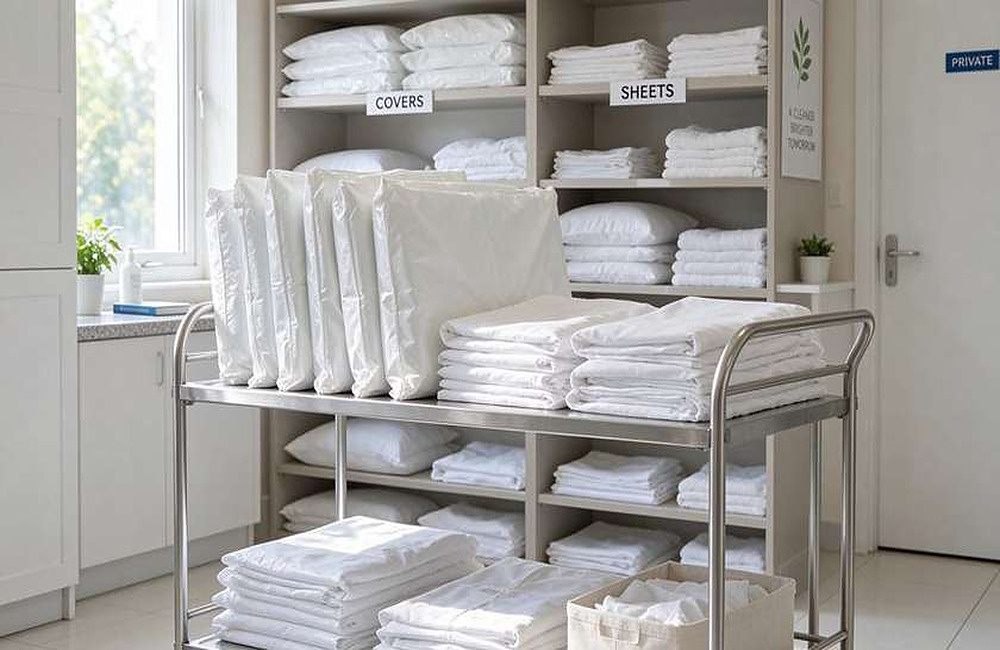
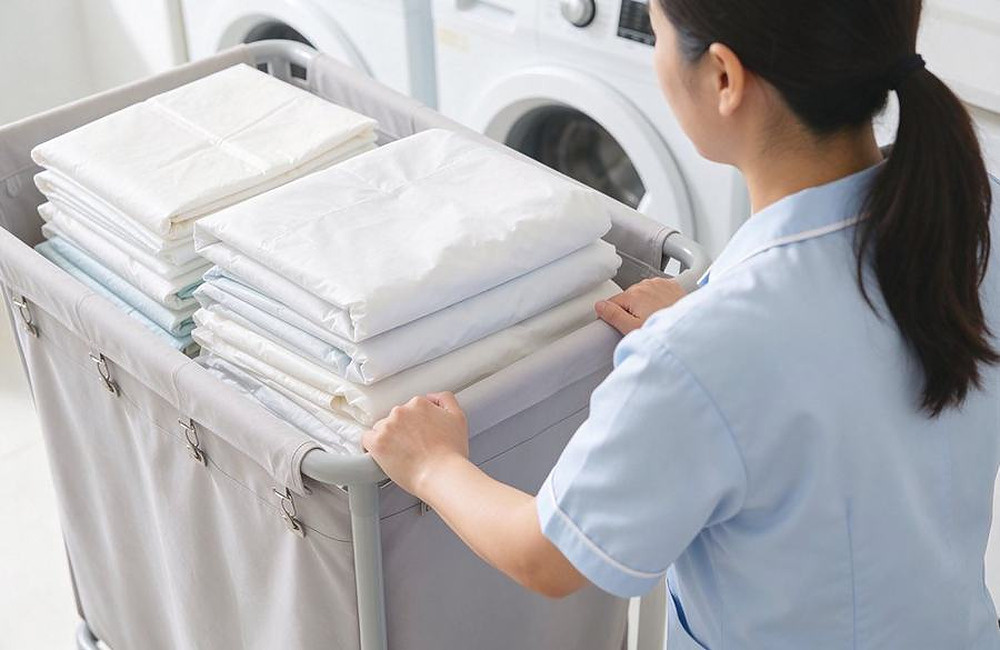
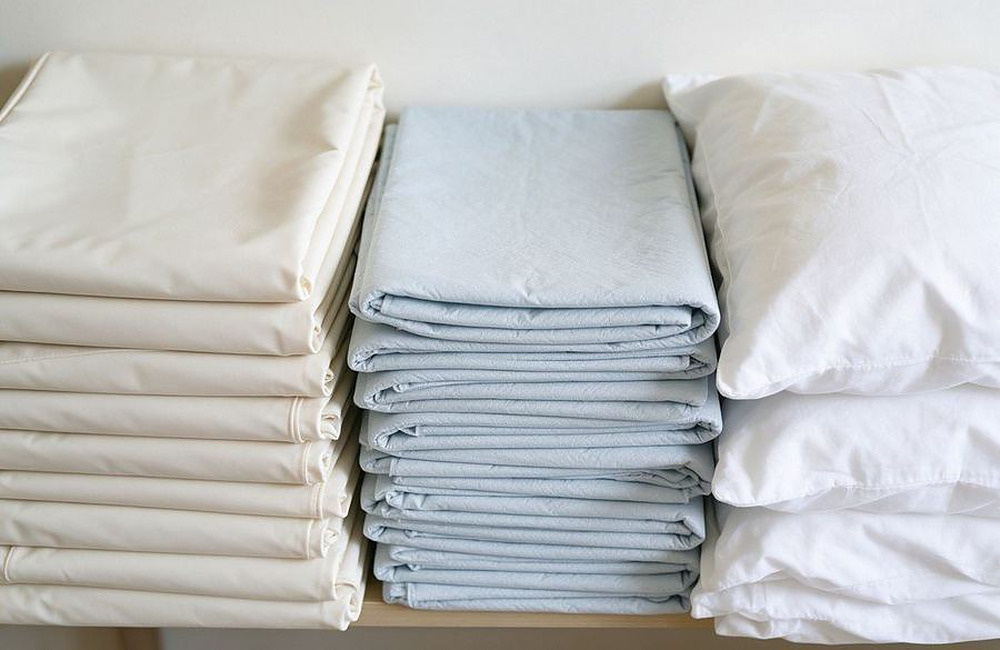
Covers and pads stacked for a shift: the stock level that keeps a 3-par rotation working without a full shelf of single-use packs.
Product figures on this page are typical ranges for institutional laminated bedding and are intended for specification discussion, not as a guarantee for a particular lot.
Test values should be confirmed against certificates for the article offered. Limits for harmful substances in textiles, including bedding and towelling, are published by OEKO-TEX.
Freundliche Links :
Urheberrechte © © Custom Disaster - Relief Bedding: Tents, Sleeping Bags, Blankets Alle Rechte vorbehalten
das professionelle Team zum Service !